Golden-ratio lamps cast in sand moulds with ENSAM students, 2018

Pouring into the sand mould. Arts et Métiers (ENSAM), Lille. Photo © Christophe Guérin, 2018
To test and develop the fill-and-drain process, we needed a basic form: a bowl, a symmetrical vessel of revolution, the simplest geometry to cast. I drew a series of simple forms based on the proportions of the golden ratio, to create a collection of lamps.
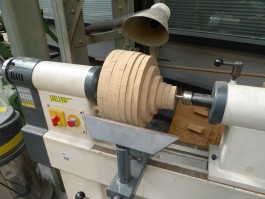
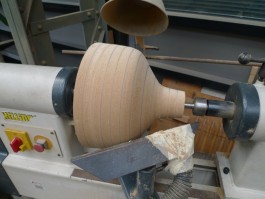
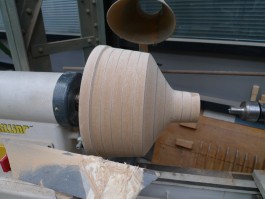
In the first semester, I worked with students of Arts et Métiers (ENSAM) in Lille to turn the models in wood. In the second semester, we made sand moulds from these wooden models and cast the pieces in aluminium.


Photo © Christophe Guérin, 2018
This first test campaign was instructive but inconclusive: sand does not exchange heat well enough to solidify the aluminium skin quickly, so the skin grows thick and the piece heavy. This led to the metal mould of the next version.


Photo © Christophe Guérin, 2018
How we got there, in three steps: turning the wooden patterns, making the sand moulds, then fill-and-drain casting.
The patterns were turned on a wood lathe from blanks glued up in stacked rings, then sanded and varnished so that they would release cleanly from the sand.

Arts et Métiers (ENSAM), Lille. Photo © Christophe Guérin, 2018

Arts et Métiers (ENSAM), Lille. Photo © Christophe Guérin, 2018


Arts et Métiers (ENSAM), Lille. Photo © Christophe Guérin, 2018

Arts et Métiers (ENSAM), Lille. Photo © Christophe Guérin, 2018
Arts et Métiers (ENSAM), Lille. Photo © Christophe Guérin, 2018

Arts et Métiers (ENSAM), Lille. Photo © Christophe Guérin, 2018

Arts et Métiers (ENSAM), Lille. Photo © Christophe Guérin, 2018
Each wooden pattern was rammed into sand inside a two-part steel flask. The flask was then opened, the pattern removed, and the two halves closed again around the cavity, ready to receive the metal.

Arts et Métiers (ENSAM), Lille. Photo © Christophe Guérin, 2018

Arts et Métiers (ENSAM), Lille. Photo © Christophe Guérin, 2018


Arts et Métiers (ENSAM), Lille. Photo © Christophe Guérin, 2018

Arts et Métiers (ENSAM), Lille. Photo © Christophe Guérin, 2018

Arts et Métiers (ENSAM), Lille. Photo © Christophe Guérin, 2018
The mould is filled with molten aluminium. After a few seconds, a skin solidifies against the walls of the mould; the mould is then tipped to drain the remaining liquid metal back into the crucible. What remains is a shell, its inner surface covered with aluminium crystals.

Arts et Métiers (ENSAM), Lille. Photo © Christophe Guérin, 2018

Arts et Métiers (ENSAM), Lille. Photo © Christophe Guérin, 2018


For a second series, I drew new forms and turned them in wood; the renderings show the lamps they were meant to become. We stopped there: our first tests showed that the sand mould was not conclusive.

Arts et Métiers (ENSAM), Lille. Photo © Christophe Guérin, 2018

Arts et Métiers (ENSAM), Lille. Photo © Christophe Guérin, 2018

3D renderings © Christophe Guérin


Year2018
TypeResearch, Product design, Teaching
ContextEnsadLab (PhD research), Arts et Métiers (ENSAM), Lille
StudentsArts et Métiers (ENSAM), Lille, 2017–2018
ProcessFill-and-drain casting, sand mould
Photos© Christophe Guérin