Pour un design implémentable, thesis and defence, Paris, 2022

The manuscript, two volumes, 2022. Photo © Christophe Guérin
My PhD thesis, Pour un design implémentable, asks how design can engender things that can actually be implemented under the conditions of a finite world. It builds on Bruno Latour’s Down to Earth and treats the limits of a finite world as a positive constraint for design. The question was tested in practice, through furniture, objects, prototypes and material experiments, from recycled carbon fibre to cast aluminium and glass; many of them have their own page in the index.
The manuscript and its appendices, which document each experiment, can be downloaded at the bottom of this page (in French).
Research question
In a context of climate emergency that confronts us with the limits of a finite world and leads us to question the direction of our production systems, how can the practice of an “implementable design” enlist actors and actants to “faire faire” and “faire être” “Terrestrial” agents, taking part in a change of course, a “landing”?
Abstract
The question of an implementable design emerged from our research as the outcome of a design practice that we wanted to be not merely implantable, but integrated within the conditions of a finite world. Implementation is neither an implantation nor an installation: it is not a matter of adding, “function by function” (Gilbert Simondon), but of joining together, or positively hybridising, synergies. By implementing, we modify the initial system. We therefore hold that this modification must engender a lasting implementation and, reciprocally, the viability of the system over time. To do so, it must agree with the system’s conditions of feasibility, which are not only economic but material, under the conditions of a finite world. The aim is therefore not to produce but, in Bruno Latour’s words, to innovate by taking advantage of these limits.
Models of the circular economy and of the functional economy, of so-called “positive” design and design “with intent” (McDonough and Braungart), and the principles of ecological design (Victor Papanek) have already been developed. Yet although many tools and methods exist, they are only weakly implemented in today’s production system. What is this inability to act that prevents us from making it evolve? Within the framework of research-creation, through the practice of design, we propose to counter the inertia of a production system and of its “Out-of-This-World” agent (Latour), and to turn to the “Terrestrial” agent (actors, actants, the animate, the acting), which may allow new models to emerge and new inertias to take hold, in order to “land” (Latour).
Design may be seen as a minor agent in the face of this global problem and the complexity of our production system. In many cases it serves as a tool that keeps the system in place, producing ever more novelties and feeding a communication system built on fast (short-cycle) feedback loops. Our practice-based research therefore humbly seeks other paths, to show that design is not merely a tool that maintains the system, but can bring about long-cycle feedback loops that propose new directions to it, so that it may endure and prosper.
Keywords: Design praxis · Feedback loops · Complexity · Engendering · Re-valuing · Circular economy
Download · Manuscript, PDF, 496 p. ↓ · Appendices, PDF, 212 p. ↓ · in French


SupervisorEmmanuel Mahé (HDR), Director of Research, EnsadLab
Co-supervisorDominique Peysson Gonin, artist and researcher in arts and sciences
Co-advisorPatrick Renaud, designer, head of the Symbiose research group
President of the juryStéphane Vial (HDR), Professor, School of Design, Université du Québec à Montréal (UQAM)
ReviewersStéphane Vial (HDR), UQAM; Nicolas Maranzana (HDR), Associate Professor, Arts et Métiers, Product Design and Innovation Laboratory (LCPI)
MembersStéphanie Monjon (HDR), Laboratoire d’Économie de Dauphine (LEDa), Université Paris-Dauphine; Patrick Renaud, designer
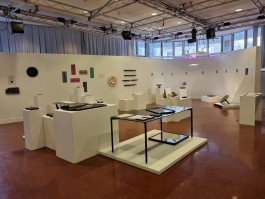
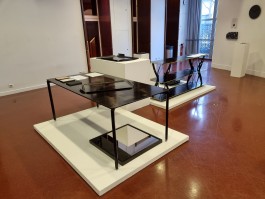
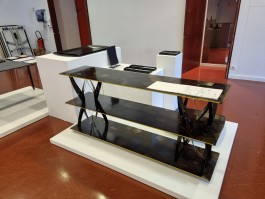
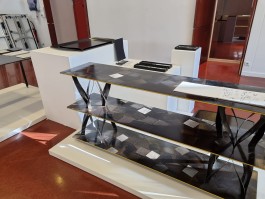
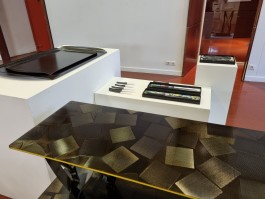
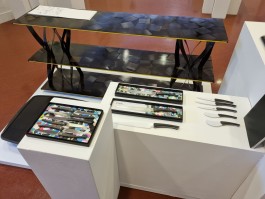
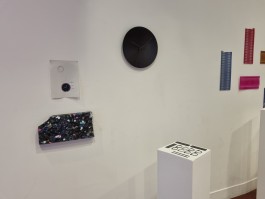
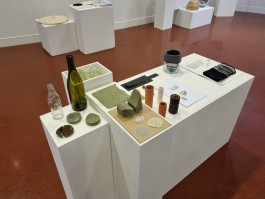
On 5 January 2022 I defended the thesis in the Rotonde of the École des Arts Décoratifs in Paris. The defence took place inside an exhibition of the work the research had produced: furniture, objects, prototypes and material samples, laid out so that the argument could be followed through the things themselves.

The defence before the jury, 5 January 2022.


Guests at the defence, 5 January 2022. Photos © Christophe Guérin


PhD defence, 5 January 2022, in the Rotonde of the École nationale supérieure des Arts Décoratifs (EnsAD), Paris.
Photo © Christophe Guérin

Photo © Christophe Guérin

Photo © Christophe Guérin

Photo © Christophe Guérin

Photo © Christophe Guérin

Photo © Christophe Guérin

Photo © Christophe Guérin

Photo © Christophe Guérin
Year2022
TypeResearch
ContextPhD research
EventThesis defence and exhibition
Date5 January 2022
PlaceRotonde, École des Arts Décoratifs, Paris
InstitutionPSL University, SACRe, EnsadLab
ThesisPour un design implémentable. Une recherche sur l’engendrement par le design, pour une implémentation dans les conditions d’un monde fini
English titleToward an implementable design. Research on engendering through design, for implementation under the conditions of a finite world
Images© Christophe Guérin
ManuscriptPDF, in French, 496 pages, 14 MB ↓
AppendicesPDF, in French, 212 pages, 9 MB ↓