Slow mobility, speculative work, 2024

AI-assisted image
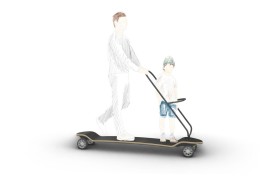
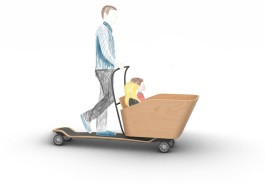
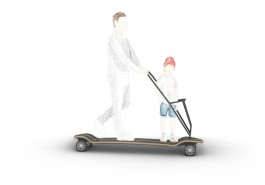
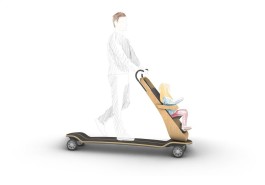
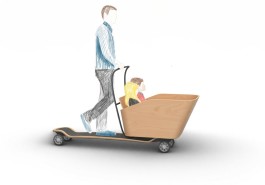
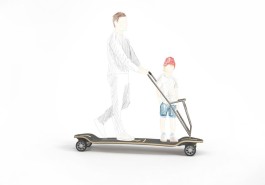
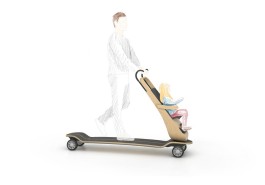
What if the skateboard became a shared vehicle, the way the bicycle became the cargo bike? This speculative study, developed with Stephan Vaast of Comet Skateboards (USA), explores a family of longboards for several users and several uses (stroller, duo, cargo) as an inclusive means of soft mobility for the last mile.
The starting point was a story told by skateboarders. Around the lake in Annecy, a cycle path draws tourists every summer. In recent years, several shops have opened there to rent skateboards to people who have never skated, and not electric ones. They rent longboards with big wheels, which get over kerbs, pebbles, potholes, cobbles and grass more easily than small wheels. Big wheels make the board quicker to learn. That is what it takes to reach beyond expert skateboarders and grow the community of riders.

3D model and drawing © Christophe Guérin

3D model and drawing © Christophe Guérin
The aim was not a classic skateboard in a new material, but a new kind of board, with a real impact on mobility and the ecological transition, able to support a research and development grant. Starting from an existing 3D model, I explored a combination of wood and carbon. A 15 mm wooden deck is reinforced where needed by a 5 mm carbon board underneath, so a longer board can be built from smaller sheets of wood. The carbon stays hidden, so that a damaged board does not expose fibres that could cut hands or legs.
The carbon shell is fully three-dimensional, like the body of a racing car or a 1970s buggy. It carries integrated lights and wheel arches that act as mudguards, the kind of safety and comfort equipment found on a bicycle. The wooden surface stays simple and clean.
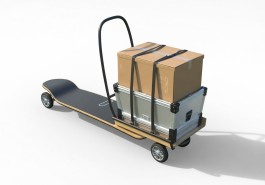
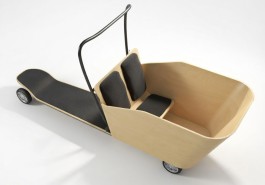
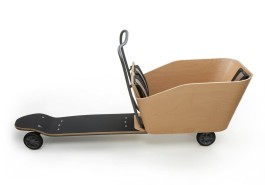
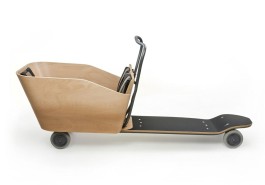
Longboard-strollers, longboard-cargos and longboard-wagons are beginning to appear. From there, I explored a longer board, up to 1.50 m or more, close to a snowboard, and turned it into a collection: a stroller with a child’s seat in plywood, folded aluminium tubes and textile; a duo board with a wishbone borrowed from windsurfing, hinged so the board folds for storage; a reinforced boom with a headlight for night riding; a U-cargo, inspired by longtail bikes, with a bench made from an ordinary skateboard; a front container, inspired by cargo bikes, for two children or for boxes.
Heavier loads raise the question of braking, with disc or drum brakes as on a bicycle. They also raise the question of steering a long board: should it turn like a scooter or like a skateboard?

3D model and drawing © Christophe Guérin

3D model and drawing © Christophe Guérin

3D model and drawing © Christophe Guérin

3D model and drawing © Christophe Guérin

3D model and drawing © Christophe Guérin

3D model and drawing © Christophe Guérin
The last mile also concerns goods. A cargo-only board, lighter than a bicycle, could carry boxes from a warehouse to a customer’s door, or from a barge port to the city centre, the way bike-trains already deliver supermarket food in town. For delivery fleets, small assist motors could make sense where a private rider would not need them.

3D model and drawing © Christophe Guérin

3D model and drawing © Christophe Guérin

3D model and drawing © Christophe Guérin
Further iterations test other forms. A flat board without wheel arches has a pram version with wheels cut out of the wood, which raises the question of protection from rain and mud. A carbon-only neo-retro shell has its surface intersected in plan with the outline of a rocket, close to an old Batmobile or a 1970 Corvette. A structural carbon board carries the trucks, under a curved plywood deck that shields the rider from mud and water; the deck is cut open to reach the truck screws, and the opening doubles as a carrying handle. The relationship between the flat board and the curved one gives something new.
The study remains at the research stage, and nothing is fixed. I do not skateboard, so some technical limits escape me. The next step would be to build and test, starting with the maximum length a board can have and still be steered in town. A modular board that grows with the children, or with needs, remains an open question.

3D model and drawing © Christophe Guérin


AI-assisted image
AI-assisted image
AI-assisted image
AI-assisted image
AI-assisted image
AI-assisted image
AI-assisted image
AI-assisted image
AI-assisted image
AI-assisted image
AI-assisted image
YearNovember 2024
TypeSpeculative design
ClientComet Skateboards, USA, with Stephan Vaast, head of production and design
Images3D modelling and drawing © Christophe Guérin; images marked as such are AI-assisted