Pour-and-tip casting for an aluminium refinery, 2016–2017

Before fill-and-drain, there was pour-and-tip: couler-renverser.
In 2016, with the engineering consultancy Néo Éco Recycling and the Baudelet Environnement aluminium refinery, I set out to make objects at the refinery itself, straight from the molten secondary aluminium, without remelting ingots in a foundry.


Baudelet Environnement aluminium refinery: wheel rims, sorted scrap and secondary aluminium ingots, March 2016. Photo © Christophe Guérin
A refinery is not equipped like a foundry. The process therefore had to be cheap, low-tech and simple to run, and the objects had to make the most of what the metal does on its own: the irregular, sparkling surface left by the crystallisation of the aluminium, which makes every piece unique.

Usually, the refinery melts aluminium waste into ingots, which are sold and shipped to a foundry, remelted, and only then turned into objects. The idea was to create a loop inside the process itself.
Producing on site cuts out this detour: the same furnace and the same molten metal would make both the ingots and the finished objects. A shared industrial tool, on the principle of the commons, that would also improve the refinery’s yield.

Drawing © Christophe Guérin, 2016.
Outer loop: aluminium waste → sorting → secondary raw material → casting → ingot production → sale and transport → aluminium foundry → ingots remelted → objects made → distribution → selective collection and drop-off.
Inner loop: process innovation → innovative on-site production → eco-design.
The foundry workshop of Arts et Métiers (ENSAM) in Lille.

I presented my research question to Philippe Costes, professor of foundry at Arts et Métiers in Lille: how to produce an object in the simplest, low-tech way, inside an aluminium refinery. In return, he introduced me to his own personal research on fill-and-drain casting (couler-vidanger) and showed me his trials, carried out as part of an internal project at Arts et Métiers. This was the starting point of our collaboration on Al Crystallography.

First hollow casts in an existing amphora mould, by Philippe Costes, 2016. Photo © Christophe Guérin

The tool is an open cast-iron mould mounted on a pivot. Molten aluminium is poured in; a skin solidifies against the cast iron; the mould is then tipped over and the surplus, still liquid, flows straight back into the furnace. No sand moulding, no feeders, no particular skill, and no scrap.
The targets were walls under 2 mm, a cycle of about one minute, and moulds lasting some 8,000 casts in cast iron, or 1,000 in aluminium. Since only a shell remains, the process makes hollow parts.

Drawing © Christophe Guérin, 2016.
A: molten aluminium is poured into the cast-iron mould.
B: the aluminium solidifies on contact with the cast iron, through its thermal inertia.
C: the mould is tipped and the surplus aluminium emptied.
During the 2016–2017 school year, we tested the principle in the workshop, with an ingot-shaped mould mounted on a pivot. Each pour left a thin shell: smooth on the mould side, and on the free face, the crystallisation of the aluminium.

Tipping the mould, December 2016. Photo © Christophe Guérin


Shells cast by pour-and-tip, December 2016. Photo © Christophe Guérin


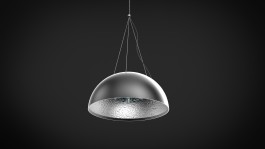
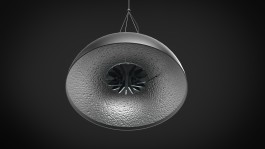
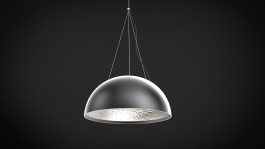
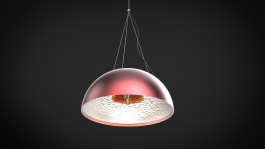
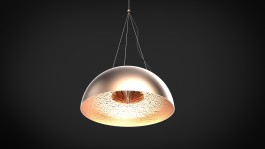
The first objects were to be a range of lamps, so that light would bring out the crystallography of the aluminium. Hollow objects would follow with new moulds: tables, chairs, technical parts.


3D study. Rendering © Christophe Guérin, 2016
3D study: the crystallised face inside the shade. Rendering © Christophe Guérin, 2016
3D study. Rendering © Christophe Guérin, 2016
3D study: shade anodised in part, lit from behind by LEDs. Rendering © Christophe Guérin, 2016
After many tests and experiments in the workshop, Philippe and I concluded that the process was not optimal and could be improved. Tipping out the still-molten aluminium caused three major defects: a safety risk from splashes; uneven parts, since the molten metal stayed in contact with one side of the mould longer while it was emptied; and a risk that the opposite wall, freshly solidified and therefore fragile, would collapse.
This first experiment laid the ground for the fill-and-drain process (couler-vidanger), developed afterwards with Arts et Métiers and patented as part of my thesis.
Year2016–2017
TypeResearch, Product design
ContextArts et Métiers (ENSAM), Lille
PartnersNéo Éco Recycling, engineering consultancy; Baudelet Environnement, aluminium refinery
FoundryPhilippe Costes, Arts et Métiers (ENSAM), Lille
ProcessPour-and-tip casting (couler-renverser), open cast-iron mould on a pivot
Drawings, photos© Christophe Guérin