Street furniture, planters and glassblowing from glass recycling residues, 2017–2018

Glass fines at a collection and recycling site in the north of France. Photo © Christophe Guérin
A research project carried out during my pre-doctoral year at EnsadLab, on circular economy loops and on design as a way to give value to residual waste that cannot be recycled. Looking for unused deposits of material, I turned to Néo Eco Recycling, a consultancy specialising in circular economy, which showed me several: among them, glass fines, and glass beads, both those used in sandblasting booths and those mixed into road-marking paint, which rumble under the wheels when you drive over the lines.
Glass is often thought to be endlessly recyclable. Yet when bottles are recycled, only part of the glass goes back into new bottles: the fines, residues too small to be reused, end up in landfill. I chose to work with this secondary raw material, 100% glass, to give value to this waste and encourage industries to look again at what they discard.

Glass recycling site. Photo © Christophe Guérin

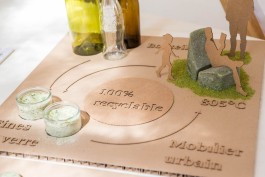
The cycle of glass fines, from bottle recycling to urban furniture. Diagram © Christophe Guérin

Sample of fused glass fines. Photo © Christophe Guérin
Its qualities match the needs of street furniture: durable, inert, dense, heavy and solid. The process is simple and cheap: an annealing kiln, and moulds in inexpensive materials such as refractory plaster, concrete or clay. The fines fuse at around 890 °C, against 1,200 °C for glassblowing, so shaping them takes less energy.
With Jean-Pierre Masson, glass teacher at the Lycée Lucas de Nehou in Paris, I developed the firing curves that turn the fines into a vitrified, non-porous piece.

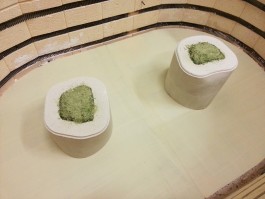
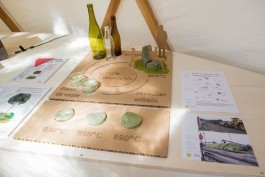
Firing tests at 830, 850 and 890 °C: at 890 °C the material vitrifies. Photo © Christophe Guérin
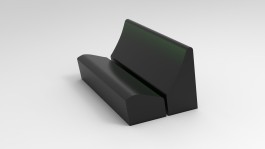
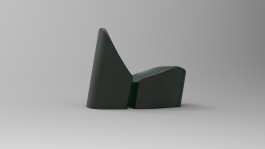
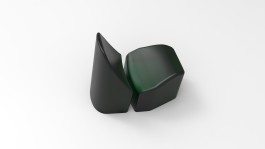
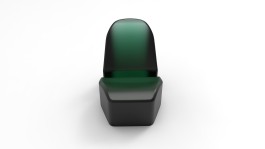
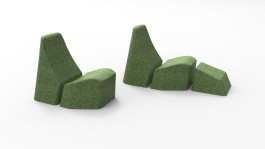
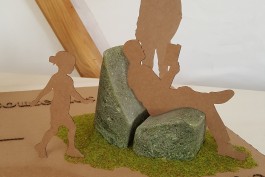
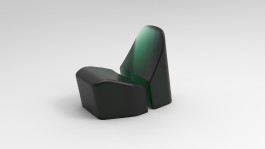
A seat in glass fines, entered in a design competition in Lyon on the theme “Reinventing glass in urban space”. Two green monolithic blocks, like rocks hidden in an island of plants, invite city dwellers to take new paths and find a quiet spot in the heart of the city.
Splitting the seat in two lets rainwater drain away; the blocks evoke a stone worn by time, or green icebergs emerging from the ground, a reminder of our impact on the environment.

Seat in glass fines. 3D rendering © Christophe Guérin
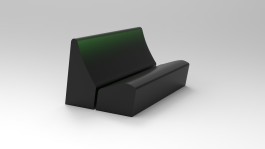


Volume studies for the seat. 3D renderings © Christophe Guérin, 2017


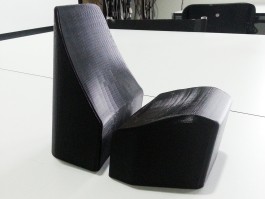
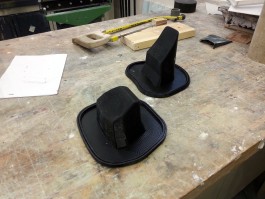
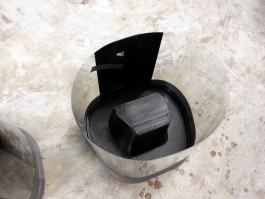
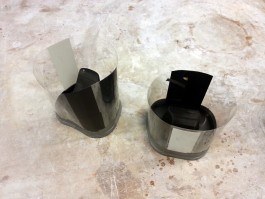
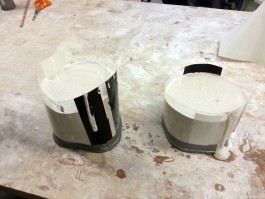
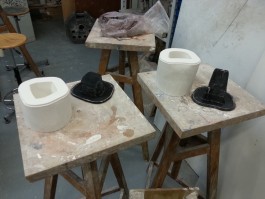
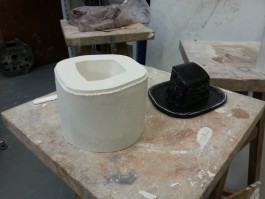
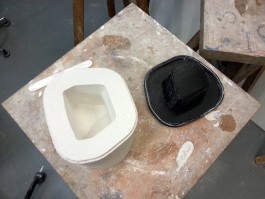
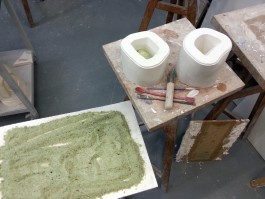
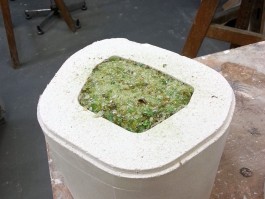
Prototypes of the seat, scale 1:10: models, moulds and fired pieces. Photo © Christophe Guérin
Glass fines behave much like sand. A second concept fills modular planters with them, assembled in a network as an urban vegetable garden: tomatoes grow in the glass sand.

Tomato plants growing in glass sand, 2017. Photo © Christophe Guérin

Planter concept: glass modules assembled in a network.

3D rendering © Christophe Guérin
The cycle of glass fines, from bottle recycling to an urban vegetable garden. Diagram © Christophe Guérin
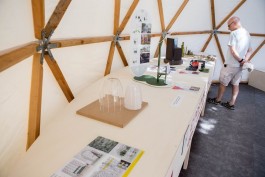
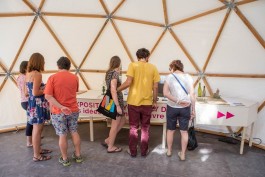
The project was shown at Lyon City Demain, des idées pour mieux vivre la ville, from 15 to 18 June 2017: the seat at scale 1:10, the fired samples and the cycle of the material.


Lyon City Demain, 15–18 June 2017. Photo © Pierre-Aymeric Dillies
Model of the seat at the exhibition. Photo © Christophe Guérin
Photo © Pierre-Aymeric Dillies
Photo © Christophe Guérin
Photo © Pierre-Aymeric Dillies
I then continued the research with the Écomusée de l’Avesnois in Trélon and the master glassblower Jean-Baptiste Pinel, to try blowing the fines. Coming from bottle recycling, they are a “short” glass, made to cool quickly for fast, low-cost production: it can be remelted and blown, but only into a mould, not worked freely.
The experiment opened another direction: using the fines as a natural colourant. We blew a glass bubble and rolled it on a bed of fines. They gave it texture and caught the light: a poor material, a waste, that sparkles like crystal or a precious stone. This gap between a poor material and a luxurious appearance is, for me, a way to add value through design, shifting our perception from the disgust of waste to the attraction of a reflection.

Glassblowing with glass fines,

Écomusée de l’Avesnois, Trélon, 2018.

Photo © Christophe Guérin

Glass bubble rolled on a bed of glass fines. Glassblowing: Jean-Baptiste Pinel. Photo © Christophe Guérin
Néo Eco Recycling had also shown me other deposits of glass waste: beads from sandblasting booths and from road-marking paint. These first melting tests close the loop where the project began.


Melting tests with glass beads from sandblasting and road marking. Photo © Christophe Guérin
Year2017–2018
TypeResearch
ContextEnsadLab
DepositsNéo Eco Recycling
FiringJean-Pierre Masson, Lycée Lucas de Nehou, Paris
GlassblowingJean-Baptiste Pinel, Écomusée de l’Avesnois, Trélon
ExhibitionLyon City Demain, des idées pour mieux vivre la ville, 15–18 June 2017
Photos© Christophe Guérin; exhibition © Pierre-Aymeric Dillies