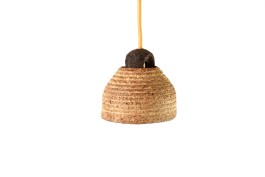
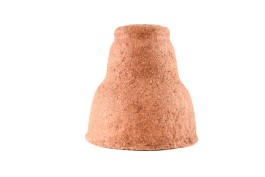
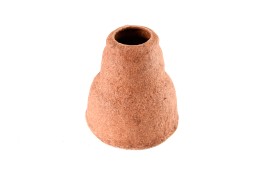
Pendant lamps in coffee grounds, sawdust and sodium silicate, 2016

Lamps in coffee grounds. Photo © Christophe Guérin

Low footprint objects started from one idea: using pollution (CO₂) as a raw material, to produce while depolluting and consume while depolluting. The note at the end of this page says what remains of that idea.
The objects are made from waste mixed with sodium silicate, a mineral binder that absorbs CO₂ as it hardens. I discovered this “liquid glass” in the foundry workshop of Arts et Métiers, where I have worked since 2011, and wanted to explore it further for making functional objects. The fillers are secondary raw materials, waste that would otherwise be discarded: coffee grounds, wood dust, short fibres or scoria, shaped in moulds. Néo Eco opened the doors to the industrial waste deposits I worked with.


Coffee grounds stored at Gecco, Lille. Photo © Christophe Guérin

Sawdust from the wood industry. Photo © Christophe Guérin


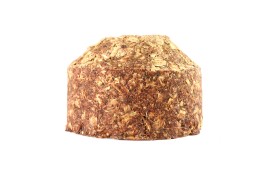
The first waste is coffee grounds, collected in Lille from the company Gecco. The resulting material is strong and light. After many samples and tests, the design turned to a lamp, an object that could recreate the atmosphere of a café: its smell, its warm light, its soft shapes.
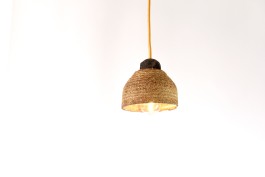
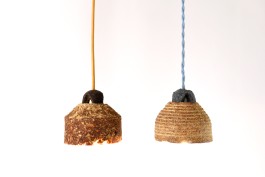
The lamp is made only of waste and a mineral binder: coffee grounds, wood dust, short natural fibres and sodium silicate. It is light and soft to the touch, and gives a warm light.
The second waste is sawdust, collected from companies in the wood industry through Néo Eco and Baudelet Environnement. Mixed with the same binder, it gives a material just as strong and light as the coffee one, and lighter in colour.


Sketches for the pendant lamps. Drawings © Christophe Guérin


Raw materials, mixing, moulds and cast pieces. Photo © Christophe Guérin

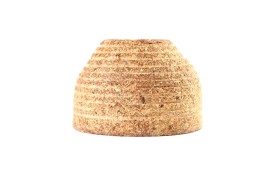
I tried colouring the material with natural pigments, and adding flax fibres and sawdust to give it texture and strength. Many moulds of different shapes were made, and pieces were cast both inside and outside the mould, so that each has one smooth face and at least one rough, handmade-looking face.

Variations in colour and texture.

Photo © Christophe Guérin
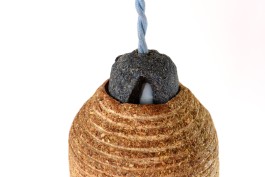
The second part of the lamp is its core: an open structure that ventilates the lamp and carries the shade. It is made from sawdust and coffee grounds collected from industries in Lille, cast in a 3D-printed mould. The piece is strong, light and durable.

The core, cast in a 3D-printed mould. Photo © Christophe Guérin

The core, lit.

Photo © Christophe Guérin

Cores in sawdust and coffee grounds.


The lamp, off and on.

Photo © Christophe Guérin

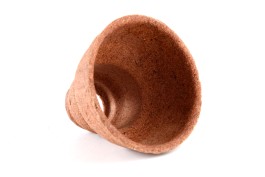
Bowl and lampshade in coffee grounds.

Photo © Christophe Guérin
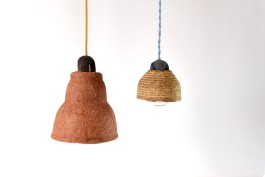
The same lamps were then cast in sawdust, and in mixes of sawdust and coffee grounds.

Casting tests in sawdust.

Photo © Christophe Guérin

Test piece and lamp in sawdust.

Photo © Christophe Guérin


Lamps in sawdust, and in sawdust and coffee grounds. Photo © Christophe Guérin
Sodium silicate absorbs CO₂ as it hardens mainly because CO₂ is released when it is made: as it cures, the material only takes back the CO₂ it lost, and the energy and transport involved are not compensated. On its own, the balance is not positive.
What the project explores lies elsewhere: turning waste and industrial by-products, such as sawdust, coffee grounds or scoria, into the body of an object, held together by a mineral, non-toxic binder instead of a petrochemical resin, with as few means and as little energy as possible. This search for economy of means continued in my doctoral research, notably with aluminium crystallography. Producing the silicate with waste heat, for instance, could improve the balance. The work remains exploratory: a direction rather than a finished product.
Year2016
TypeResearch
ContextEnsAD
FrameworkMaster 2 in object design, École des Arts Décoratifs, Paris, taken as an independent candidate, with highest honours; a first step towards my doctoral research on circular economy loops and the revaluation of waste through design
Waste depositsNéo Eco
Coffee groundsGecco, Lille
SawdustBaudelet Environnement
Photos and drawings© Christophe Guérin